
From Vulnerability Scanning to Remediation: How to Decide What to Fix First
Decide what to fix first after a vulnerability scan. Prioritise findings by asset criticality, exposure and business risk, then verify remediation.
Our products
The compliance platform built by our cybersecurity practice. Its built-in AI automates the gap analysis for NIS2 and the Czech Cybersecurity Act.
Cybersecurity
What Zero Trust is, its core principles and benefits, and how it supports the risk-management measures that NIS2 requires.
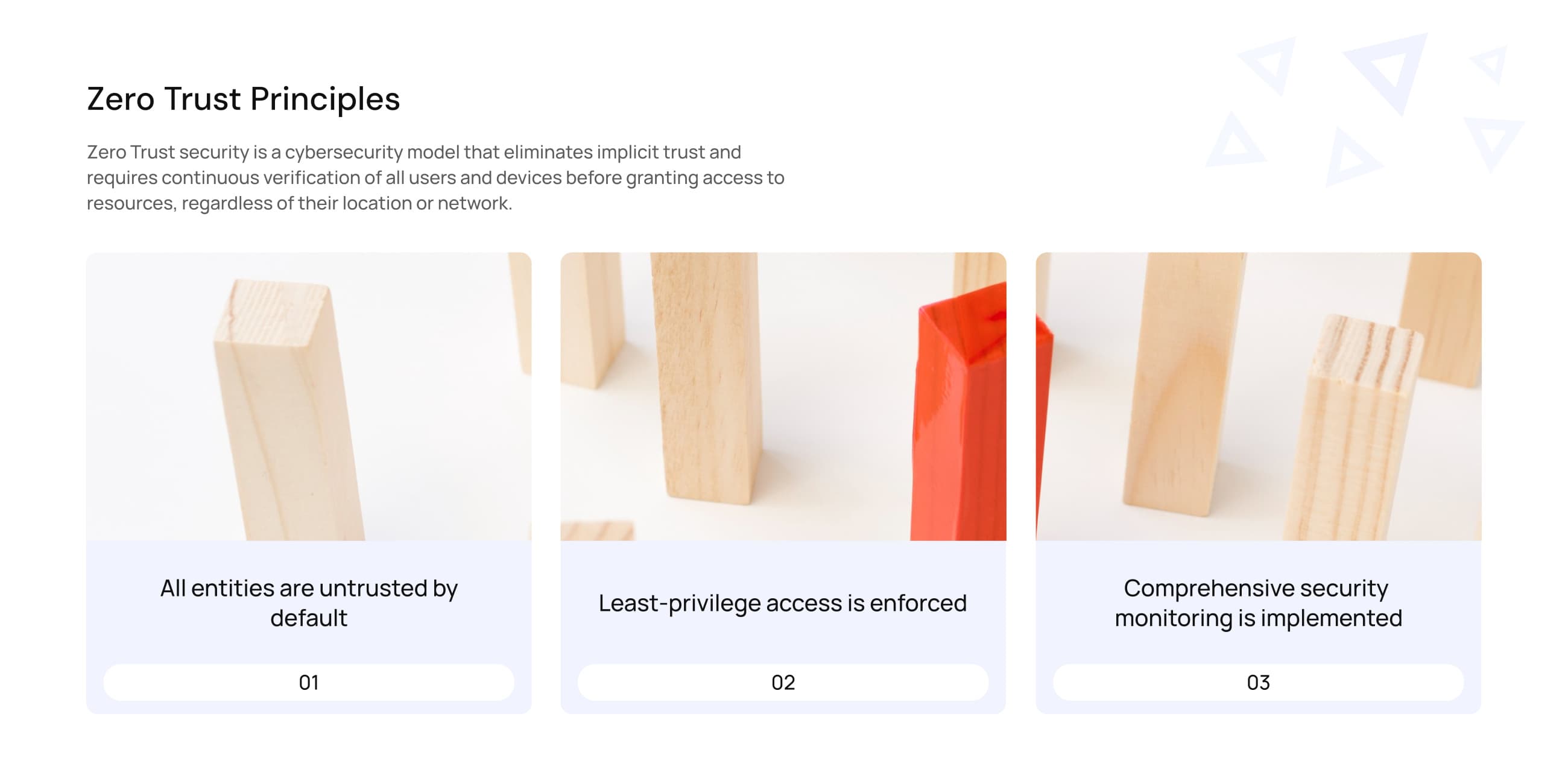
The EU's Network and Information Security Directive (NIS2) requires a wide range of organisations to take cybersecurity risk-management measures, such as access control, multi-factor authentication and supply chain security. It does not prescribe a particular security model, but it names zero-trust principles among the basic cyber hygiene practices that organisations should adopt. Zero Trust reflects the limitations of traditional perimeter-based security models in the face of increasing cyber threats and evolving work environments.
Zero Trust is a departure from traditional "castle-and-moat" security models that focused on securing the network perimeter while implicitly trusting those within. With the rise of cloud computing, remote work and increasingly sophisticated cyber threats, the perimeter has become blurred, and Zero Trust has become an important approach to modern network security.
In essence, Zero Trust security eliminates implicit trust and requires continuous verification and validation of every access attempt. It enables organisations to better protect their sensitive data and assets as threats become more complex and change faster.
NIS2 expands the scope of organisations subject to cybersecurity regulation to include sectors like food production, postal services, manufacturing and digital providers. Its Article 21 requires them to take appropriate and proportionate risk-management measures. Several of the minimum measures it lists are areas where Zero Trust principles apply directly:
The Czech Cybersecurity Act works the same way. It lists access control, identity management and the security of communication networks among the security measures in both obligations regimes, without prescribing Zero Trust. Zero Trust is a way to meet these requirements, not a requirement of its own.
Zero Trust, a modern security approach, offers significant benefits over traditional security models:
By implementing Zero Trust principles, organisations can limit access to resources based on the principle of least privilege. This means that users are only granted the minimum level of access necessary to perform their job functions. This approach reduces the attack surface and makes it more difficult for attackers to move laterally within the network.
Additionally, continuous monitoring of user activity allows for the detection of anomalous behaviour and potential threats. This can help organisations to quickly identify and respond to security breaches. As a result, implementing Zero Trust principles can help organisations to improve their security posture and reduce the risk of data breaches.
Zero Trust provides organisations with a comprehensive view of network activity and potential vulnerabilities. By collecting and analysing data from various sources, organisations can gain deeper insights into user behaviour, network traffic and system configurations. This improved visibility enables security teams to identify and remediate threats more effectively.
Zero Trust supports several of the risk-management measures that the NIS2 Directive requires of organisations in the European Union. By adopting Zero Trust principles, organisations can demonstrate their commitment to cybersecurity best practices and enhance their overall security posture. Compliance with NIS2 requirements can also help organisations build trust with customers, partners and regulators.
Zero Trust puts access control and continuous monitoring at the centre, so access rules follow users and resources rather than network locations. This can make security management more consistent and simplify parts of the security infrastructure.
Zero Trust enables organisations to provide users with simple and secure access to resources, irrespective of their location or device, which can improve productivity and employee satisfaction.
Zero Trust is a flexible security model that adapts to changes in the IT environment. Organisations can add or remove users, devices and applications without compromising the security of their systems.
Implementing Zero Trust is often hindered by the complexity of achieving least-privilege access and continuous monitoring. A 2024 Ponemon Institute study for Entrust found that 61 % of organisations had begun to adopt Zero Trust, which leaves almost four in ten that had not, and that a lack of skills and budget were the biggest obstacles.
With NIS2 obligations now applying (in Czechia, within one year of the decision registering a regulated service), organisations should evaluate their current security posture. Key questions to consider include:
Zero Trust is not a legal requirement of NIS2, but it is a practical way to meet several of its measures, from access control to multi-factor authentication. By adopting this security model, organisations can strengthen their defences, reduce the risk of cyberattacks and demonstrate their commitment to protecting sensitive data and critical infrastructure. We help organisations put it into practice through network segmentation and Zero Trust access and identity and access management.
Decide what to fix first after a vulnerability scan. Prioritise findings by asset criticality, exposure and business risk, then verify remediation.

What should you prepare in the first year after registering a regulated service? A ZoKB checklist covering risks, security measures, incidents and recovery.

Learn which GRC activities can be automated, where AI adds value, and why evidence, control and risk decisions still require expert human judgement.
Tell us what you need to secure, automate, build or staff. A senior consultant will get back to you.
 Aleš PoláčekCEO, Whirr Crew
Whirr Crew s.r.o., Rybná 716/24, 110 00 Praha 1