
From Vulnerability Scanning to Remediation: How to Decide What to Fix First
Decide what to fix first after a vulnerability scan. Prioritise findings by asset criticality, exposure and business risk, then verify remediation.
Our products
The compliance platform built by our cybersecurity practice. Its built-in AI automates the gap analysis for NIS2 and the Czech Cybersecurity Act.
Cybersecurity
What NIS2 requires in practice: risk-management measures, incident reporting, supervision and penalties, under the directive and under the Czech Cybersecurity Act.

NIS2 has applied across the EU since 18 October 2024, and in Czechia through the Cybersecurity Act (Act No. 264/2025 Coll.) since 1 November 2025. The directive replaced the 2016 NIS Directive and requires organisations in sectors like energy, banking, manufacturing and digital services to manage their cybersecurity risks, report significant incidents and accept supervision, with an emphasis on supply chains and vulnerability handling. This article looks at the obligations, deadlines and penalties in detail. For an overview of what NIS2 is and whom it covers, start with What is the NIS2 Directive?
NIS2 applies to public and private sector entities that meet the following criteria:
Some entities are subject to the rules regardless of their size, and Member States may bring other entities within scope. In Czechia, the list of regulated services and their conditions are set by decree No. 408/2025 Coll.
A covered entity's supply chain is affected indirectly. Supply chain security, including the relationships with direct suppliers and service providers, is one of the minimum measures of the NIS2 Directive. Under the Czech Act, a regulated provider must choose its suppliers in line with its security measures and write those requirements into its contracts.
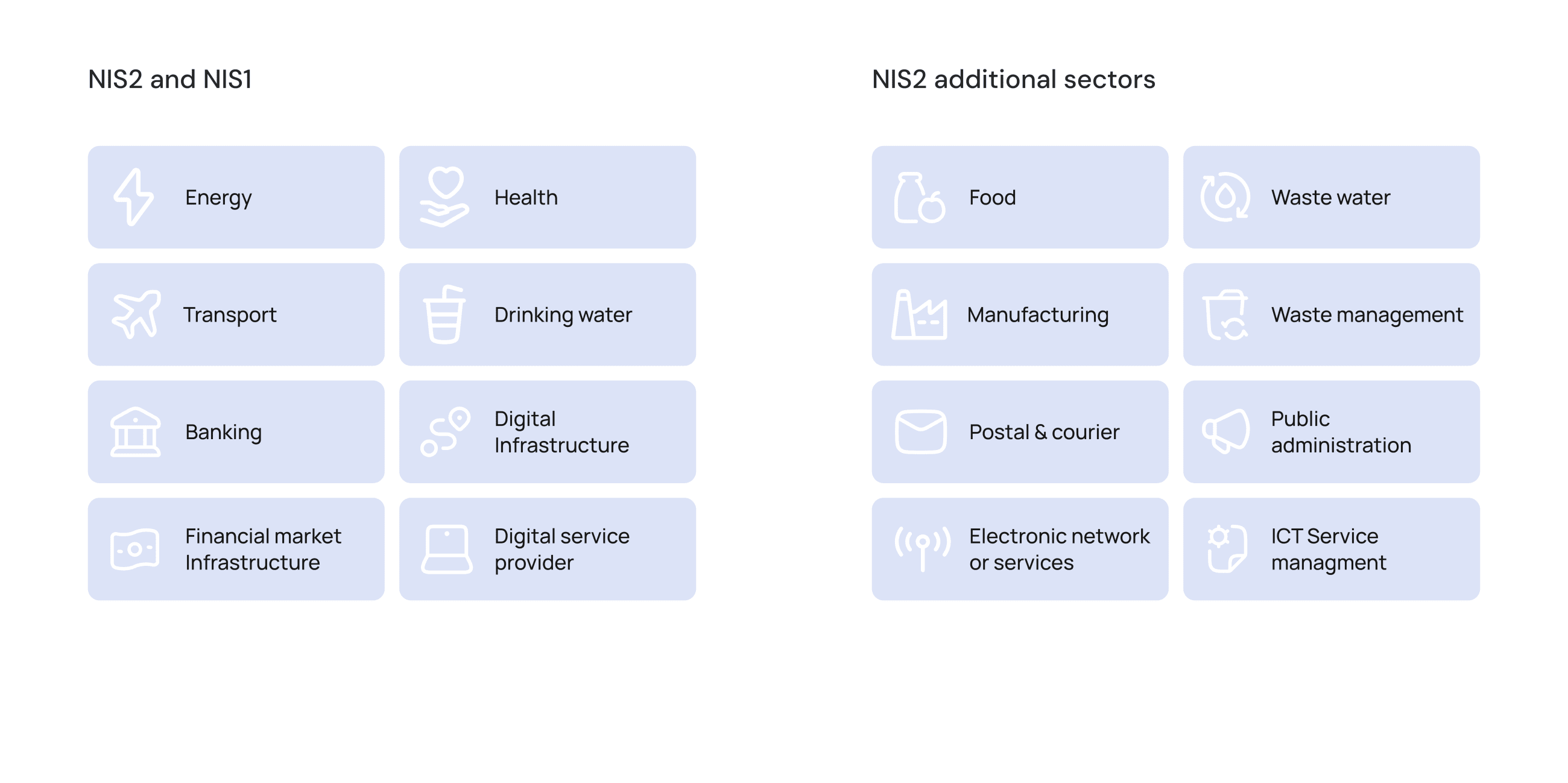
NIS2 significantly broadens the reach of cybersecurity regulation compared to its predecessor, from seven sectors to eighteen. New sectors are included based on their digital dependence, interconnectedness and importance to society and the economy, and medium-sized and large organisations in these sectors, including public ones, now fall under NIS2.
While exemptions exist, companies should carefully assess their position and any other relevant regulations. If your organisation works in one of these sectors and has 50 or more employees, or an annual turnover and balance sheet total both above EUR 10 million, it is likely to be covered. How sector and size decide between essential and important entities is explained in our overview of the NIS2 Directive.
NIS2 places significant obligations on organisations, particularly concerning cybersecurity risk management and incident notification.
The Czech Act does not use the labels "essential" and "important". It sorts providers of regulated services into a higher and a lower obligations regime, and one organisation always has one regime: if any of its services is in the higher regime, the higher regime applies to all of them.
NIS2 differentiates between essential and important entities in supervision and enforcement, based on their criticality and impact on society. Both must implement cybersecurity measures and report incidents, but essential entities face stricter supervision and enforcement, including proactive inspections and higher fines.
Under Act No. 264/2025 Coll., NÚKIB can order a provider to remedy the deficiencies it finds and can impose fines of up to:
In the higher regime, NÚKIB can also temporarily ban a member of the statutory body from office, for at least six months, if they repeatedly or seriously breach their duties and so frustrate a decision ordering the provider to remedy deficiencies.
NIS2 now applies through national law. If you have not yet done so, assess whether your organisation falls within its scope and, if it does, work through the obligations that apply to you. In Czechia, the one-year deadlines run from the delivery of your registration decision.
A compliance gap assessment shows where you stand against these obligations, and NIS2 implementation closes the gaps, as we did for IMA.
The NIS Directive is repealed and NIS2 applies through national law. Its expanded scope and stricter requirements leave no room for complacency.
Cybersecurity is continuous work. Addressing the NIS2 obligations early protects your operations and shows your stakeholders that you take their protection seriously.
The time to act is now. If your registration decision was delivered around the turn of 2025 and 2026, your one-year deadline falls around the turn of 2026 and 2027. What to have in place by then is in our ZoKB checklist.
Decide what to fix first after a vulnerability scan. Prioritise findings by asset criticality, exposure and business risk, then verify remediation.

What should you prepare in the first year after registering a regulated service? A ZoKB checklist covering risks, security measures, incidents and recovery.

Learn which GRC activities can be automated, where AI adds value, and why evidence, control and risk decisions still require expert human judgement.
Tell us what you need to secure, automate, build or staff. A senior consultant will get back to you.
 Aleš PoláčekCEO, Whirr Crew
Whirr Crew s.r.o., Rybná 716/24, 110 00 Praha 1