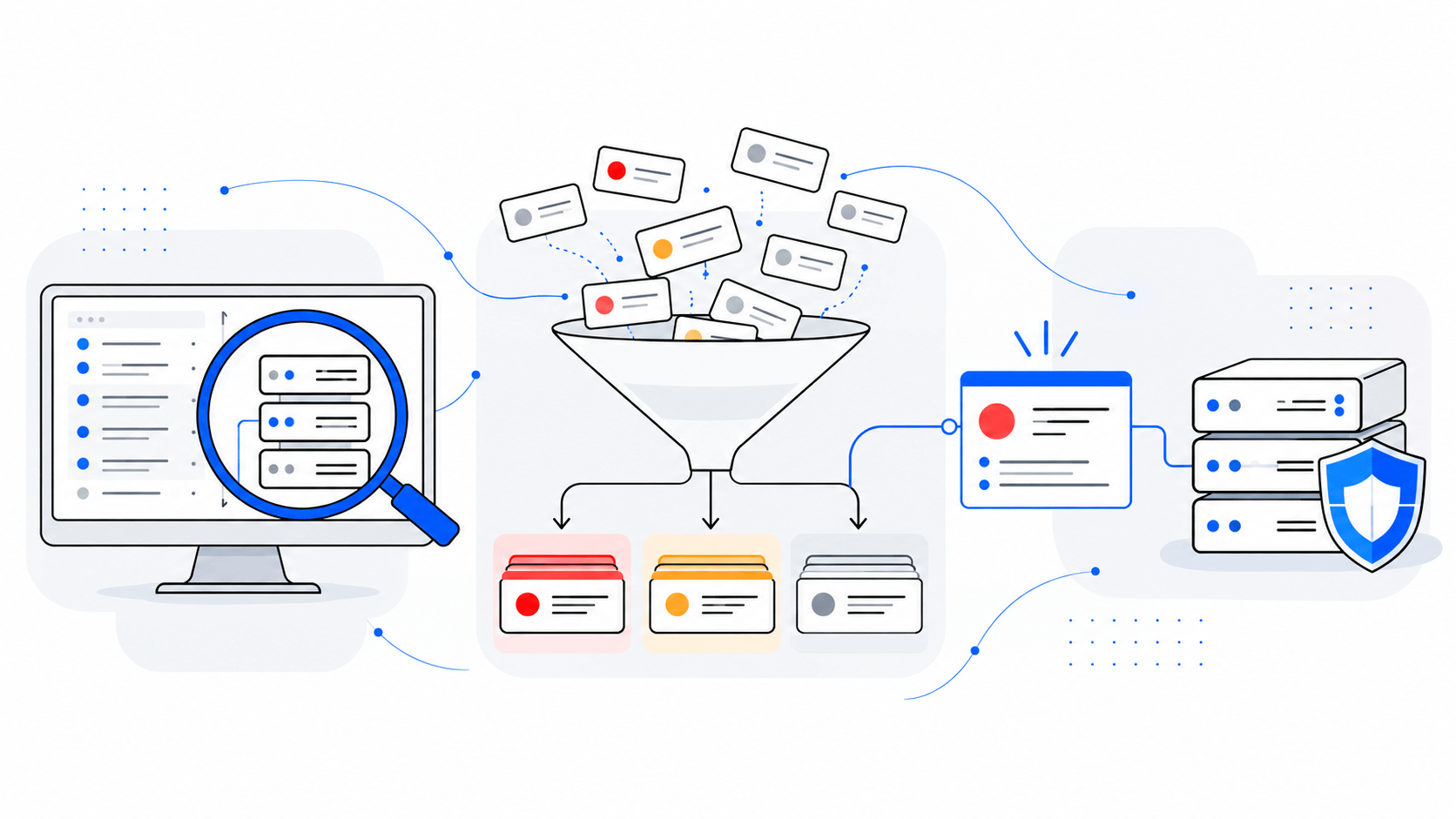
From Vulnerability Scanning to Remediation: How to Decide What to Fix First
Decide what to fix first after a vulnerability scan. Prioritise findings by asset criticality, exposure and business risk, then verify remediation.
Our products
The compliance platform built by our cybersecurity practice. Its built-in AI automates the gap analysis for NIS2 and the Czech Cybersecurity Act.
Cybersecurity
NIS2 is the EU-wide legal framework for stronger cybersecurity. What it is, whom it covers, how it differs from NIS and how it applies in Czechia through the Cybersecurity Act (264/2025 Coll.).

NIS2 is the EU law that replaced the original NIS Directive and raised the bar for cybersecurity across Europe. It requires organisations in a much wider range of sectors to manage their cybersecurity risks, report significant incidents and involve their management in both. Member States have had to apply it since 18 October 2024; in Czechia it applies through the Cybersecurity Act, Act No. 264/2025 Coll., in force since 1 November 2025. What is the directive, how does it differ from its predecessor, and where does it stand today?
NIS2 is a directive, so it binds Member States rather than companies directly: your obligations come from the national law that transposes it. The key dates of Directive (EU) 2022/2555 are:
Czechia transposed NIS2 through the new Cybersecurity Act (zákon o kybernetické bezpečnosti, ZoKB), Act No. 264/2025 Coll., in force since 1 November 2025. Three decrees of the National Cyber and Information Security Agency (NÚKIB) took effect on the same day: No. 408/2025 Coll. on regulated services, and Nos. 409/2025 and 410/2025 Coll. on security measures in the higher and the lower obligations regime.
So there is no single compliance date for a Czech company: the clock runs from the day your registration decision was delivered. How to tell whether the Act covers you is the subject of our article on self-identification mistakes under the Czech law, and what to complete in the first year is in our ZoKB checklist.
The NIS2 Directive, a successor to the original Network and Information Security (NIS) Directive, marks a significant evolution in the European Union's approach to cybersecurity. It builds on the foundation laid by its predecessor and sets a common, higher level of cybersecurity across the Member States.
The NIS2 Directive serves as a tool for strengthening the EU's cybersecurity. Its core objectives include:
The most striking contrast between NIS1 and NIS2 lies in their scope. NIS1 covered operators of essential services in seven sectors (energy, transport, banking, financial market infrastructures, health, drinking water and digital infrastructure) and three types of digital service: online marketplaces, online search engines and cloud computing.
NIS2 casts a wider net, with 18 sectors. Among others, it adds waste water, space, ICT service management, public administration, postal and courier services, waste management, chemicals, food, manufacturing, research and further digital providers such as social networking platforms. Within these sectors it generally applies to medium-sized and large organisations, and to some regardless of their size.
In short, the NIS2 Directive introduces several major changes compared to the original NIS Directive:
Both essential and important entities must report significant incidents, and they do so in stages: an early warning within 24 hours of becoming aware of the incident, an incident notification within 72 hours and a final report within one month of the notification. How the stages, supervision and fines work, including the Czech rules, is covered in NIS2 obligations: rules, deadlines and penalties.
The NIS2 Directive brings more rigorous compliance requirements, covering risk management, incident reporting and supply chain security. Meeting them may take significant investment, particularly for smaller entities and those in newly included sectors, but it also brings benefits.
Compliance strengthens cybersecurity resilience, can give a competitive advantage and can lead to operational improvements. Across the EU, common requirements should make digital infrastructure more resilient and create a level playing field for businesses.
The NIS2 Directive stresses the importance of cybersecurity risk management. Organisations in scope must systematically identify, assess and mitigate cyber risks, implement appropriate security measures and assess whether those measures work.
The shift towards a proactive approach extends to all levels of the organisation, including security awareness among staff. The directive also recognises the critical role of supply chain security in an interconnected digital world.
Under NIS2, the key differences between essential and important organisations boil down to:
Czech law does not use these two labels. It sorts providers of regulated services into a higher and a lower obligations regime under decree No. 408/2025 Coll., and one organisation always has one regime. Its maximum fines for most offences are CZK 250 million or 2 % of net worldwide annual turnover in the higher regime, and CZK 175 million or 1.4 % in the lower.
To determine whether your organisation falls under the "essential" or "important" category, consider these key factors:
In Czechia, check your services against decree No. 408/2025 Coll. or NÚKIB's calculator, which shows whether you probably provide a regulated service and in which regime.
NIS2 requires a comprehensive approach that addresses both technical and organisational aspects of cybersecurity:
The NIS2 Directive marks a significant step forward for cybersecurity in the EU. Compliance takes work, but it also gives organisations the opportunity to strengthen their cybersecurity and contribute to a more resilient digital environment.
Want to know where you stand? We help organisations with NIS2 implementation, from the first gap assessment to measures that work in daily operations.
Decide what to fix first after a vulnerability scan. Prioritise findings by asset criticality, exposure and business risk, then verify remediation.

What should you prepare in the first year after registering a regulated service? A ZoKB checklist covering risks, security measures, incidents and recovery.

Learn which GRC activities can be automated, where AI adds value, and why evidence, control and risk decisions still require expert human judgement.
Tell us what you need to secure, automate, build or staff. A senior consultant will get back to you.
 Aleš PoláčekCEO, Whirr Crew
Whirr Crew s.r.o., Rybná 716/24, 110 00 Praha 1