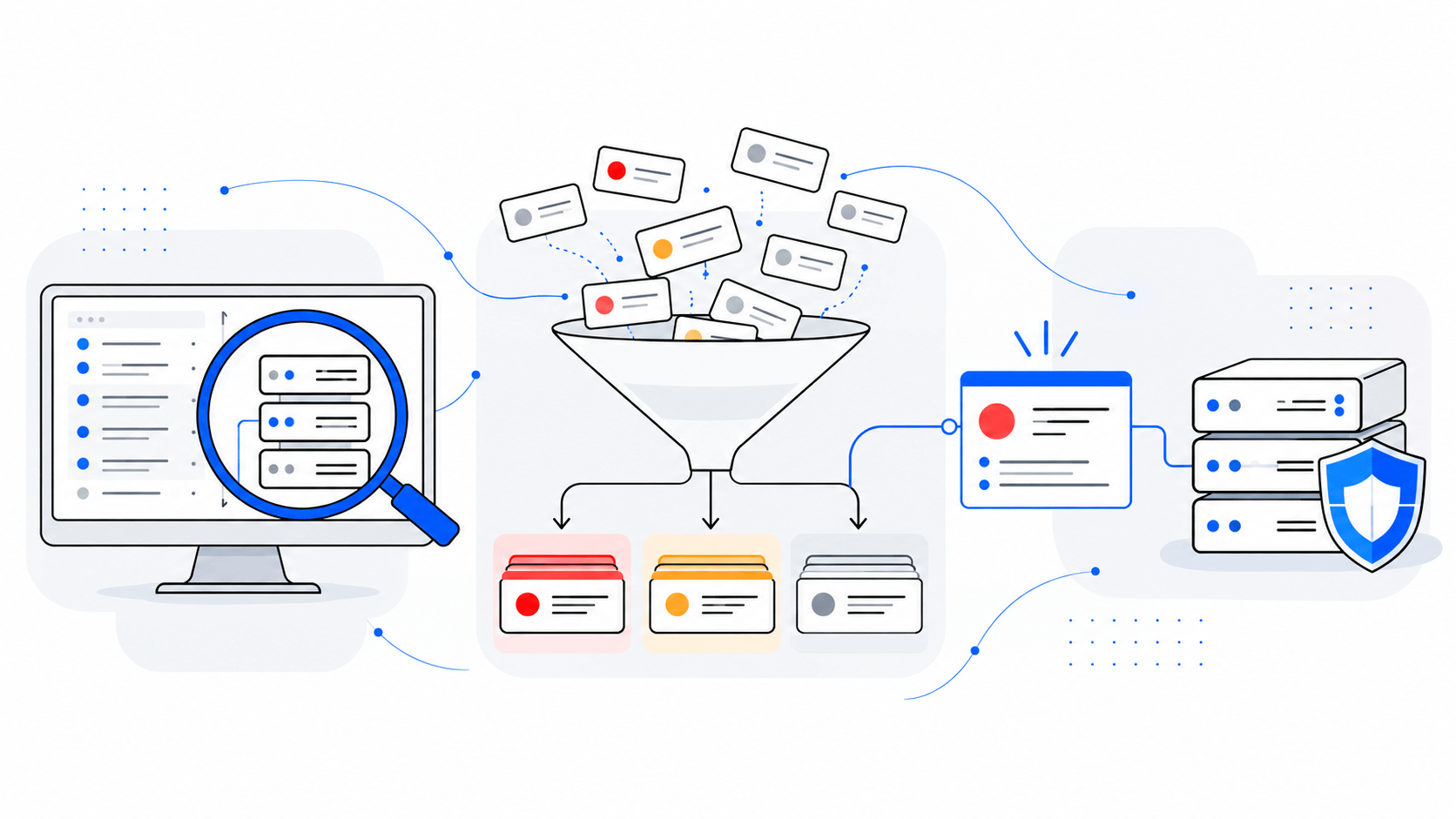
From Vulnerability Scanning to Remediation: How to Decide What to Fix First
Decide what to fix first after a vulnerability scan. Prioritise findings by asset criticality, exposure and business risk, then verify remediation.
Our products
The compliance platform built by our cybersecurity practice. Its built-in AI automates the gap analysis for NIS2 and the Czech Cybersecurity Act.
Cybersecurity
Avoid costly mistakes under NIS2 and the Czech Cybersecurity Act (264/2025 Coll.): how to self-identify correctly, understand regulated services, assess company size and regimes, and what applies to suppliers.

The NIS2 Directive has been part of Czech law since 1 November 2025, when the new Cybersecurity Act, Act No. 264/2025 Coll., came into force. Its first key obligation is self-identification: determining whether your company provides a regulated service. If it does, it must notify that service to NÚKIB within 60 days of meeting the conditions. For organisations that met them when the Act took effect, the window closed on 31 December 2025.
Many companies still stumble at this first step, so let's look at the most common mistakes and how to avoid them.
Although the National Cyber and Information Security Agency (NÚKIB) has done a great deal of awareness-raising, we still meet companies that the new obligations have not reached. The volume of regulation companies face is huge, but as the well-known legal principle says: ignorance of the law is no excuse.
The NIS2 Directive has greatly widened the circle of regulated organisations. NÚKIB has long estimated that about 6,000 organisations fall under the new Act, and by 8 February 2026, 4,825 of them had notified a regulated service. The chance that the law applies to you is real.
Why is self-identification such a key obligation? A company that should notify a regulated service and does not commits an offence, and the fine can reach CZK 250 million or 2% of the net worldwide annual turnover of the undertaking it belongs to, whichever is higher. If you find you should have notified, do it now: NÚKIB urges organisations that have not yet notified to do so as soon as possible, and says that how long the breach lasted affects any proceedings and the size of a penalty. What follows registration is described in our article on NIS2 obligations, deadlines and penalties.
The Act applies to companies that provide a service in a regulated sector and meet further criteria, usually size. Regulated services are those important for securing important social or economic activities, or for security, in the Czech Republic. They come from 15 sectors:
The exact list of services and their conditions is set by decree No. 408/2025 Coll. on regulated services.
It sounds relatively simple, so if I don't do anything in these sectors, I don't have to deal with the new law at all? Not necessarily. Some services are regulated regardless of size, and NÚKIB can register them on its own initiative: for example where the provider is a critical infrastructure entity, or where a disruption of the service could seriously affect the lives of more than 125,000 people.
A much more common mistake is to confuse your main activity with the regulated sectors. The law is interested not only in your core business but in everything you do.
Take a company that makes pet toys. It has checked that its production is not a regulated manufacturing service, and so has concluded that the law does not apply to it. But it wouldn't be a good example if that were the end of the story. The company has a subsidiary that sews dog clothes, and the parent company manages all of the subsidiary's IT and invoices it for the service. That puts it into the digital infrastructure and services sector: it could be providing a regulated managed service (MSP) or a managed cybersecurity service (MSSP). It doesn't matter that IT is not its main activity.
Companies must identify all the regulated services they provide, whether or not these are their main activity. Think about everything you do, even what seems minor at first glance. And don't forget: you can provide more than one regulated service, and you have to notify all of them.
Besides operating in a regulated sector, the typical criterion is size: the provider must be a medium-sized or large enterprise. If you carry out an activity in a regulated sector but do not reach that size, the Act generally does not apply to you, though the conditions that apply regardless of size still can.
Size is calculated according to Commission Recommendation 2003/361/EC, which defines micro, small, medium-sized and large enterprises by headcount and by annual turnover or balance sheet total.
Small companies have fewer than 50 employees, medium-sized companies 50 to 249 and large companies 250 or more. The problem is that the count must also take into account the relevant links between undertakings. What does this mean? For example, that you are a subsidiary of a large company or part of a holding. In these cases, the total also includes the employees of subsidiaries, sister or parent companies, either in full or in proportion to the degree of the link. A company with 10 employees can thus become a large enterprise thanks to its parent company.
The Act contains an exception for these cases: partner or linked undertakings are not counted if their technical assets are completely separate from the technical assets the assessed company uses to provide the regulated service. Whether your group's IT really is completely separate is worth checking carefully, and documenting.
Once you notify your regulated service, NÚKIB delivers a decision registering it, and you become a provider of a regulated service. From then on, your obligations depend on your regime: the higher obligations regime or the lower one. Decree No. 408/2025 Coll. assigns the regime, and the security measures for each are set by decree No. 409/2025 Coll. (higher regime) and decree No. 410/2025 Coll. (lower regime).
Companies make a mistake here when they provide more than one regulated service, one of which falls into the lower regime and another into the higher. They then want to prepare for both regimes at the same time, or choose the more convenient one: the lower regime. But one organisation always has one regime, and the higher regime takes precedence.
If even one of your regulated services is in the higher regime, the higher obligations regime applies to all of them.
The deadlines run from the day the registration decision is delivered. Within 30 days, you report your contact details and supplementary data. Within one year, you must implement the security measures for your regime and start reporting cybersecurity incidents. What to complete in that year is in our ZoKB checklist.
The Act also reaches suppliers of regulated organisations, mainly through their customers. A provider of a regulated service must choose its suppliers in line with its security measures and write those requirements into its contracts. In an incident affecting a higher-regime provider, NÚKIB can also order a supplier to hand over information and data related to the service. But the fact that you supply a regulated organisation does not in itself make you one.
To become a provider of a regulated service, a supplier must itself provide a regulated service and meet all the other conditions. So a supplier, like any other company, must self-identify. If it does not provide a regulated service, it does not notify NÚKIB, and the requirements reach it only through its regulated customers.
Do you already know whether the new law applies to you? NÚKIB's free calculator shows whether your organisation probably provides a regulated service and in which regime. If you want to be sure, we can assess where you stand in a gap assessment, as we did for JRD, and help you implement the measures your regime requires.
Decide what to fix first after a vulnerability scan. Prioritise findings by asset criticality, exposure and business risk, then verify remediation.
What should you prepare in the first year after registering a regulated service? A ZoKB checklist covering risks, security measures, incidents and recovery.
Learn which GRC activities can be automated, where AI adds value, and why evidence, control and risk decisions still require expert human judgement.
Tell us what you need to secure, automate, build or staff. A senior consultant will get back to you.
 Aleš PoláčekCEO, Whirr Crew
Whirr Crew s.r.o., Rybná 716/24, 110 00 Praha 1