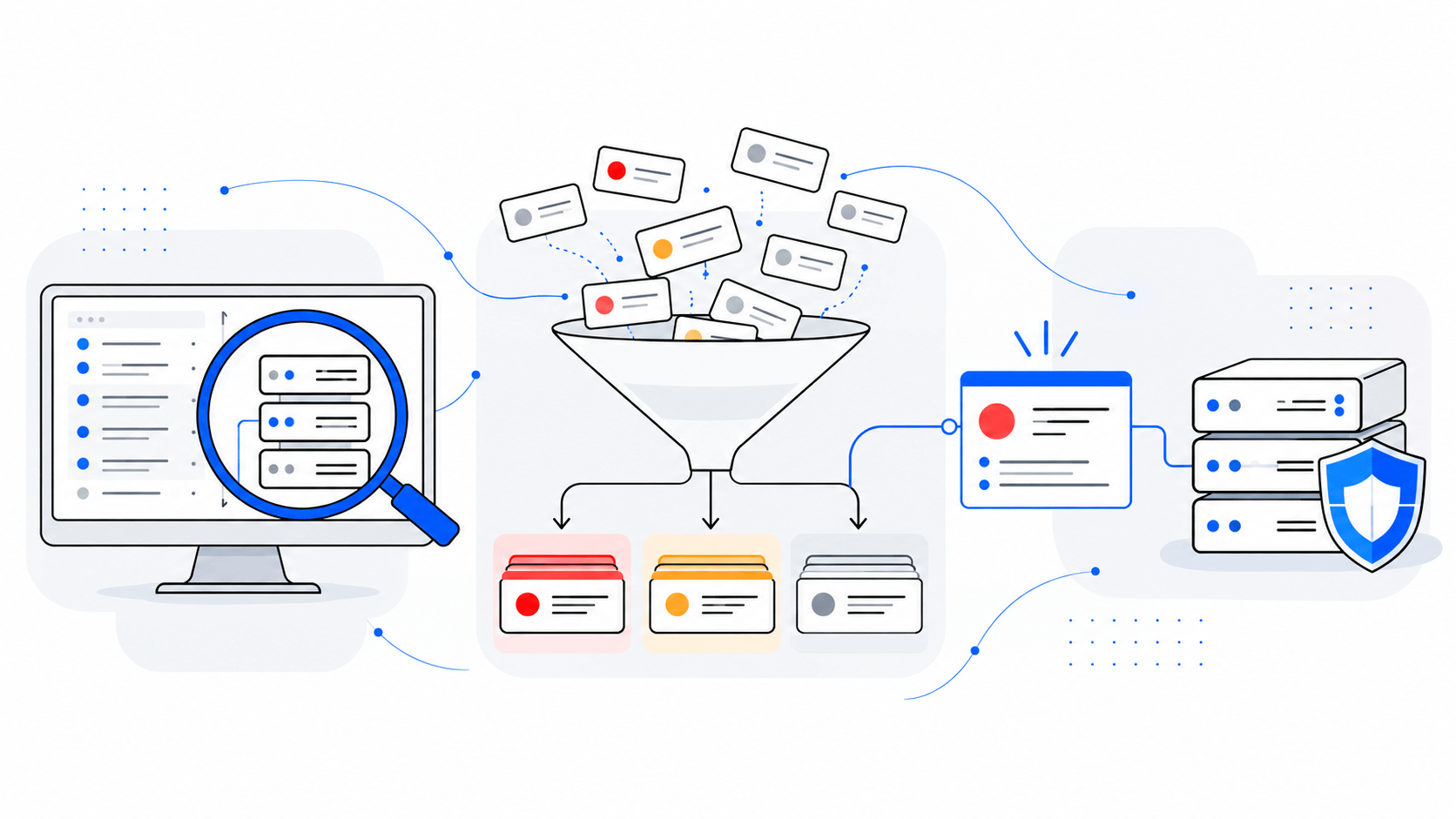
From Vulnerability Scanning to Remediation: How to Decide What to Fix First
Decide what to fix first after a vulnerability scan. Prioritise findings by asset criticality, exposure and business risk, then verify remediation.
Our products
The compliance platform built by our cybersecurity practice. Its built-in AI automates the gap analysis for NIS2 and the Czech Cybersecurity Act.
Cybersecurity
Every shop that takes cards must meet PCI DSS v4.0.1. Here is how validation works, what requirement 9.5.1 means for payment terminals and how a chain keeps evidence from every store.
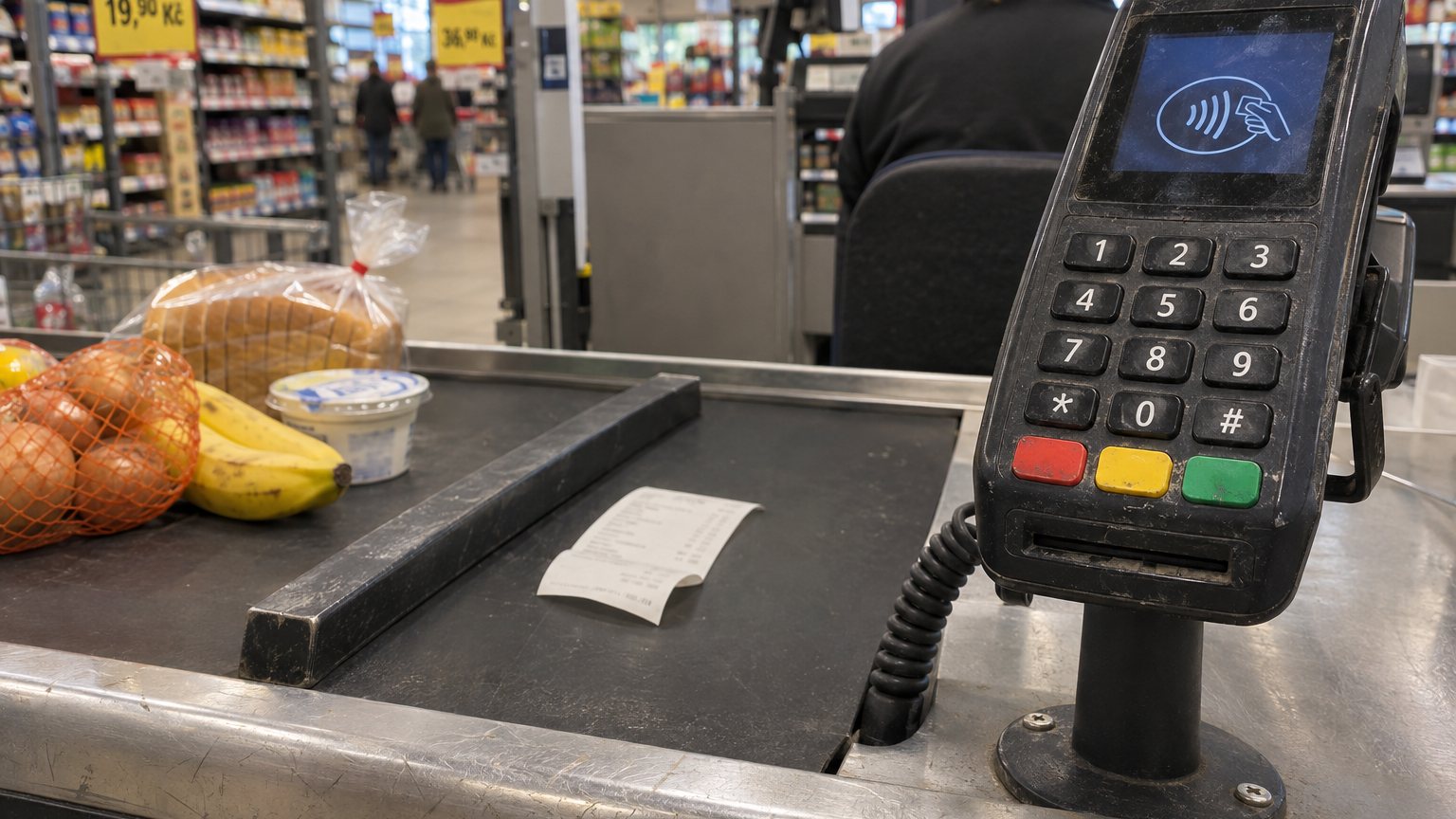
When did each of your shops last inspect its payment terminals, and what did staff find? For a chain with dozens or hundreds of locations, this is the hardest part of PCI DSS: doing the same thing in every store and being able to prove it at any time. Compare your terminal inventory with the inspection records to see which devices have no recorded result.
Requirement 9.5.1 covers payment terminals used for in-person card payments, including when a customer taps a phone or watch. It does not apply to components used only to key in card numbers or to the merchant's own off-the-shelf phones and tablets, for which PCI SSC recommends the same safeguards.
Keep an up-to-date list of every terminal with its make and model, location, and serial number or other unique identifier. An assessor compares the list with what is actually in the stores, so it has to follow every move, swap and retirement.
Inspect terminals regularly for signs of tampering or substitution (9.5.1.2). Where 9.5.1.2.1 applies, use a targeted risk analysis under 12.3.1 to set the frequency and type of inspection, and review that analysis at least every 12 months. That requirement has been mandatory since 31 March 2025.
Store staff must be trained to:
The classic case is an engineer who turns up at a store to repair or replace a terminal. Until someone has verified the visit, they should not touch the device.
In a retail chain with dozens or hundreds of shops, regular terminal inspections are a real administrative burden. Every shop has to check on a set schedule that its terminals show no signs of tampering or substitution, and keep records that prove it.
Traditionally the results go onto paper forms that stay in the shop or are scanned and emailed to head office. The security manager then struggles to see which inspections actually happened, where records are missing and whether problems are being dealt with.
AuditMaster.ai digitises and centralises the whole process. In practice a shop employee opens AuditMaster.ai, picks the terminal from the asset register and records the result of the physical inspection against a prepared checklist. If they find a suspicious change, damage or another problem, a security measure or task with an owner and a deadline can follow on from the finding.
If you suspect tampering, stop using the terminal and notify your acquirer or terminal supplier immediately.
Head office gets one view of inspections and open issues across every shop. It no longer has to chase stores by email, collect paper forms or build overviews by hand before a PCI DSS assessment.
Other routine duties can be digitised the same way:
Going digital does not replace the physical inspection of terminals or the duty to verify engineers. It removes unnecessary paperwork, makes records consistent and makes it easier to show, at any time, that controls are working. Nor does it replace independent validation by a QSA where one is required.
Not in the usual sense, as you might know it from ISO 27001 certification. The PCI Security Standards Council (PCI SSC) does not issue general PCI DSS certificates to merchants. Compliance is shown through official documents, depending on how you are required to validate.
The main documents are:
Whether a merchant needs a ROC (usually from a QSA) or can use an SAQ depends on the card brands' rules, how the merchant is classified and what the acquirer requires.
A "PCI DSS audit" usually means the assessment that ends in a ROC. Mastercard, for example, expects one every year from merchants with more than six million Mastercard and Maestro transactions combined in a year, while smaller merchants usually complete an SAQ. Check with your acquirer whether you need an SAQ or a ROC under the card brand's rules and who may carry out the assessment.
The PCI SSC sorts SAQs by how a merchant accepts cards. If you take cards both in store and online, separate SAQs for each channel are only an option when the environments are segmented from each other and each meets every eligibility criterion of its SAQ. Agree the approach with your acquirer.
| SAQ | For merchants using | Where it applies |
|---|---|---|
| B | only imprint machines or standalone dial-out terminals, no electronic card data storage | in store, mail and telephone orders |
| B-IP | only standalone PCI-approved (PTS) terminals with an IP connection to the processor, not connected to any other system, no electronic card data storage | in store, mail and telephone orders |
| C | an internet-connected payment application isolated from other systems; the POS network serves a single shop and has no connection to other premises; no electronic card data storage | in store, mail and telephone orders |
| C-VT | manual entry into a provider's web-based virtual terminal on an isolated device | in store, mail and telephone orders |
| P2PE | only terminals in a validated, PCI-listed P2PE solution, with no access to clear-text card data on the merchant's computer systems | in store, mail and telephone orders |
| SPoC | a phone or tablet with a card reader from a validated SPoC solution | attended stores |
| A | e-commerce or mail and telephone orders fully outsourced to a validated provider | online, mail and telephone orders |
| A-EP | an e-commerce site that does not receive card data but affects the security of the payment page | online |
| D | other merchants eligible for self-assessment | any channel |
For a chain this means: SAQ B-IP requires terminals isolated from tills and other types of system. For SAQ C, the POS network must serve one shop with no connection to head office or other sites. For interconnected shops, check with your acquirer whether you qualify for SAQ P2PE or SAQ D, or need a ROC.
Card payment security does not depend on the merchant alone. Payment gateways and the suppliers of terminals, point-of-sale systems, hosting and related services all play a part.
PCI DSS therefore sets rules for managing relevant service providers in requirements 12.8.1 to 12.8.5. In particular, the merchant must:
The provider's AOC (Attestation of Compliance) is a key document. Getting it is not enough: check that it covers the services you actually use, what its scope is and how security responsibilities are split. If the provider has no AOC covering your service, ask for evidence against the PCI DSS requirements it meets on your behalf.
A provider's AOC does not mean that the merchant meets its own PCI DSS obligations.
AuditMaster.ai keeps suppliers, their security assessments, the relevant documents, related risks and corrective actions in one place. That lets an organisation manage supplier risk continuously and prepare the evidence for regular validation more easily.
| Task | How often | Requirement |
|---|---|---|
| Terminal inventory | on every change | 9.5.1.1 |
| Terminal inspections | regularly; at the interval set by the risk analysis where 9.5.1.2.1 applies | 9.5.1.2, 9.5.1.2.1 |
| Staff security awareness training | on hire and every 12 months | 12.6.3, 9.5.1.3 |
| Internal vulnerability scans | every 3 months | 11.3.1 |
| External scans by an ASV | every 3 months | 11.3.2 |
| Penetration tests | every 12 months and after significant change | 11.4.2, 11.4.3 |
| Segmentation testing, if segmentation reduces your scope | every 12 months and after changes | 11.4.5 |
| Scope confirmation | every 12 months and after significant change | 12.5.2 |
| Review of targeted risk analyses | every 12 months | 12.3.1 |
| Service provider compliance status | every 12 months | 12.8.4 |
| Incident response plan test | every 12 months | 12.10.2 |
| Security policy review | every 12 months | 12.1.2 |
Which rows apply to you depends on your SAQ or ROC.
Each of the twelve breaks down into detailed sub-requirements; payment terminals, for example, sit under 9.5.1.
Larger retail chains often deal with ISO 27001, NIS2 and other regulatory and contractual requirements alongside PCI DSS.
Many of the security controls overlap. Typical examples are access management, security policies, supplier management, incident handling and risk assessment.
Managing each standard separately duplicates documents, control records, responsibilities and evidence collection.
AuditMaster.ai lets you manage several frameworks in one place and share the registers of assets, risks, policies and controls between them.
A periodic access review, for example, can be relevant to PCI DSS, to ISO 27001 and to NIS2 requirements.
Instead of several separate records, you manage one shared control with its owner, tasks and evidence, and then assess how it contributes to each regulatory requirement.
A shared record does not mean that every standard is met automatically. Each requirement still has to be assessed against its own scope.
The result is less duplicated administration, clearer security management and easier preparation for different audits and regulatory checks. We describe how we set this up under ISMS implementation.
For retail chains, knowing the PCI DSS requirements is rarely the main obstacle. The trouble usually starts with putting them in place and keeping them up across dozens or hundreds of shops.
We help retail chains prepare for PCI DSS validation and, above all, set up processes that keep the requirements met over time with as little administration as possible.
We map payment processes, terminals, point-of-sale systems, the online shop, the supporting infrastructure and suppliers. We review the architecture of the payment environment, network segmentation and the possible use of validated P2PE solutions. We help set the right scope and prepare what you need to agree the validation method with your acquirer.
We assess your organisational and technical controls against the relevant PCI DSS v4.0.1 requirements. We identify gaps and set priorities, owners and a timetable for closing them. The corrective actions and related tasks can then be managed in AuditMaster.ai, with deadlines, progress and evidence. More about our gap assessments and audits.
We set up terminal inspection records in AuditMaster.ai, logs for engineer visits and staff training, and access to current procedures. Head office gets a view of duties across all shops without collecting paper forms or contacting each store separately.
AuditMaster.ai keeps a central record of suppliers, their security assessments, relevant documents and related risks. We help set responsibilities between the merchant and its suppliers, including regular checks of their PCI DSS compliance status.
Based on the gaps found, we prepare security documentation, support the implementation of technical and organisational controls and coordinate the necessary security testing. Where an assessment by a QSA or scanning by an approved ASV is required, we work with qualified partners.
AuditMaster.ai helps collect and organise the evidence needed to show that each control is working.
PCI DSS is ongoing work. Whirr Crew can also provide continuous cybersecurity management: coordinating regular checks, updating documents, and tracking security risks, suppliers and corrective actions. With AuditMaster.ai, the same registers of assets, risks and controls also serve the related ISO 27001 and NIS2 requirements.
The result is less manual administration, a clearer picture of security in each shop and easier preparation for regular PCI DSS validation.
No. It is a card industry standard. Your merchant agreement with the acquirer makes it binding.
The PCI SSC does not impose penalties. Card brands can apply them to the acquirer, and what that means for you is set by your agreement with the acquirer.
Requirement 11.3.2 calls for a passing external scan by a PCI SSC Approved Scanning Vendor at least every three months. This includes, for example, SAQ B-IP merchants and SAQ A websites that redirect customers to a gateway or embed its payment form.
Usually SAQ A, if the gateway handles the whole payment through a redirect or an embedded form (iframe). Since 2025 a merchant with an embedded form must also confirm that its site is not susceptible to script attacks. The other options are in the table above, and we will cover online shops in a separate article.
Validation is usually repeated every year, as your acquirer requires, with the recurring tasks above running in between.
Dealing with PCI DSS for the first time, preparing for your regular validation, or looking for a way to cut the paperwork around security checks in your shops?
Discuss your PCI DSS scope and terminal inspections with our team.
Checked on 27 November 2026:
Decide what to fix first after a vulnerability scan. Prioritise findings by asset criticality, exposure and business risk, then verify remediation.
What should you prepare in the first year after registering a regulated service? A ZoKB checklist covering risks, security measures, incidents and recovery.
Learn which GRC activities can be automated, where AI adds value, and why evidence, control and risk decisions still require expert human judgement.
Tell us what you need to secure, automate, build or staff. A senior consultant will get back to you.
 Aleš PoláčekCEO, Whirr Crew
Whirr Crew s.r.o., Rybná 716/24, 110 00 Praha 1