
Will AI Steal Our Jobs? Only If We Let It
Generative AI is changing the world of work fast. What do the studies say about its effect on jobs and productivity?
Our products
The compliance platform built by our cybersecurity practice. Its built-in AI automates the gap analysis for NIS2 and the Czech Cybersecurity Act.
AI
How AI is reshaping productivity, the global economy and the future of work, according to Goldman Sachs Research and the IMF.

AI's swift advancement promises a future with heightened productivity, economic growth, and improved living standards globally. However, concerns loom over potential job losses and widening inequality. How hard will AI hit us and what should we brace ourselves for?
While investment in generative AI has surged, its tangible effects on productivity remain limited. Economist Joseph Briggs of Goldman Sachs Research attributes this to the technology's slow adoption rate, stating:
"Until we’ve seen more significant uptake in the actual application of AI, in the regular work production process, I don’t think that we’re going to see as big of an impact on productivity.”
However, early signs remain optimistic. Studies indicate an average 25% productivity increase following AI adoption, bolstering the outlook for potential gains.
Briggs highlights the complex infrastructure required for widespread AI deployment, including powerful models, reliable query handling, and significant investments in semiconductors, network capacity, and power infrastructure. These developments are underway, with semiconductor revenues up 50% and AI hardware providers seeing a $250 billion increase in forecasts.
Briggs notes that many CEOs anticipate a significant impact from generative AI in the three-to-ten-year horizon, rather than the immediate future. As a result, currently only 5% of companies report using generative AI, primarily in information services, finance, insurance, and the motion picture industry. Marketing, automation, chatbots, speech-to-text, and data analysis are the dominant use cases.
The labour market has seen minimal impact so far, with unemployment rates between AI-exposed and less-exposed occupations remaining consistent. AI-attributed layoffs account for less than 0.1% of total job separations. In fact, AI has likely spurred a net increase in employment, with a rise in job postings seeking AI skills.
While the full impact of generative AI on productivity and the labour market remains to be seen, the signs so far point towards a gradual but far-reaching shift in the years to come.
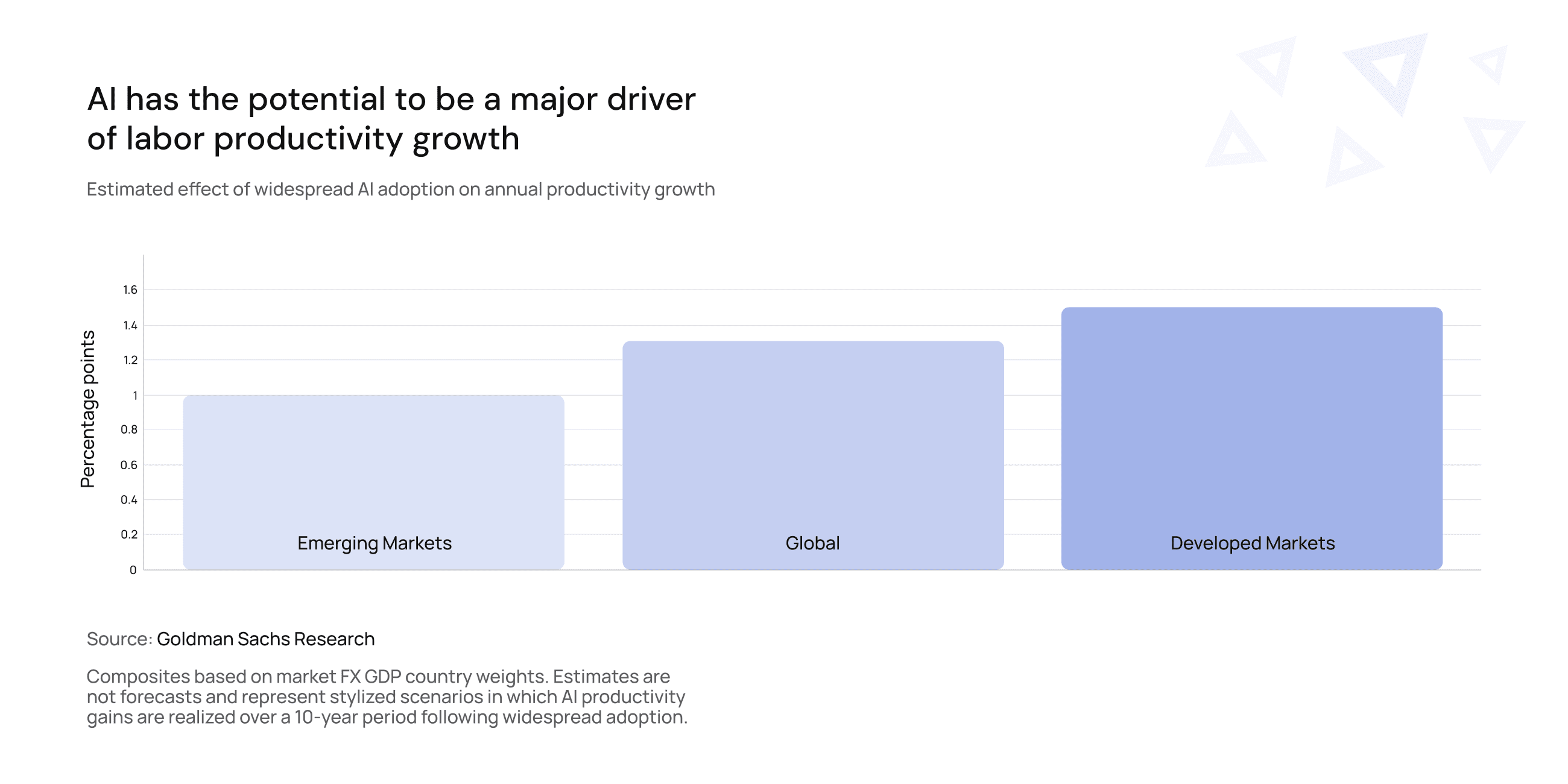
The transformative potential of AI as a productivity booster is widely recognised, but its tangible impact on country-level data remains latent. This delayed effect isn't unexpected, mirroring historical patterns seen with earlier general-purpose technologies like electricity and computers, where significant productivity gains took decades to materialise.
History teaches us that even the most transformative technologies require time to fully integrate and optimise processes. Parallels can be drawn with the productivity booms associated with electricity and computers, which occurred roughly 20 years after their introduction and peaked when around half of businesses had adopted the technology.
The initial adoption of new technology often leads to a temporary decline in productivity, attributed to changes in production methods and investments in human capital. This "J-curve effect" suggests that productivity will eventually surge significantly after the initial dip.
AI's accessibility, requiring minimal infrastructure investment, points to a potentially faster impact on productivity compared to earlier technologies. However, the J-curve effect still applies, and substantial gains might take years to manifest.
The 1990s productivity boom in the US was preceded by a surge in private investment in information processing equipment and software. A similar investment trend in AI-related technologies is likely necessary to trigger a significant macro-level productivity boost. While some positive signs exist, a broader investment boom remains elusive.
Though company-level studies showcase significant productivity gains with AI adoption (2-3 percentage points), macro-level gains might be tempered by factors like cybersecurity risks, political disruptions, and energy constraints.
Considering various offsetting influences, the net AI-driven productivity increase is likely to hover around 1 percentage point, similar to the impact of personal computers and the internet. Negative factors like population ageing and declining productivity gains from earlier innovations could further limit the overall impact.
The US, with a larger ICT sector and greater AI investment compared to Europe, is positioned to experience faster and more substantial productivity gains. Initially, these gains will likely concentrate in the technology-producing sector, later spreading across the broader economy. Countries producing AI technology, however, will likely maintain a productivity advantage.
Europe faces additional challenges, including a less developed risk capital market, language diversity, stricter data protection regulations, and anticipated regulatory pressures. These factors could further limit AI's productivity impact in the region.
AI's full impact on country-level productivity is still unfolding. Its potential is widely accepted, but historical patterns suggest a delayed effect, and realising the full productivity benefits will take patience and investment.
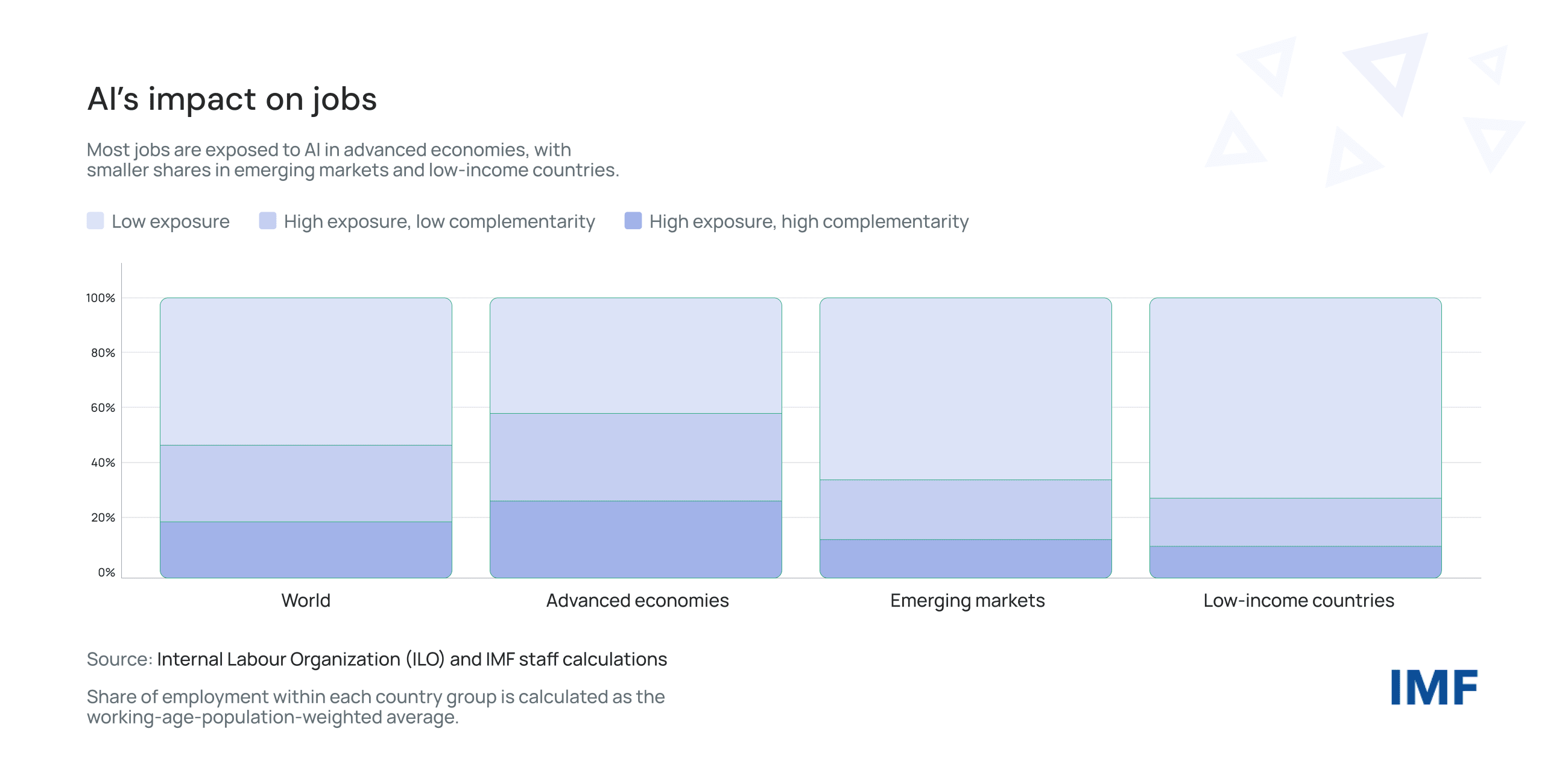
An IMF analysis highlights that while AI is likely to complement human work in many cases, roughly 40% of global employment is vulnerable. Unlike previous technological shifts, AI's impact will be felt across skill levels, particularly affecting high-skilled jobs in advanced economies.
In advanced economies, approximately 60% of jobs might be affected by AI, with half potentially seeing increased productivity. The other half could face reduced labour demand, lower wages, or even job losses due to AI taking over key tasks.
Emerging and low-income countries show lower immediate disruption risks, with 40% and 26% of jobs exposed, respectively. However, the lack of infrastructure and skilled workforce in many of these nations could hinder their ability to benefit from AI, potentially widening global inequality.
AI's influence could exacerbate income and wealth inequality within countries. Workers who use AI effectively could see higher productivity and wages, while others fall behind. Younger workers might adapt more easily, leaving older workers struggling.
Overall, AI is likely to worsen inequality, which calls for proactive policy measures such as strong social safety nets and retraining programmes for vulnerable workers.
The rapid business integration of AI underscores the urgent need for policy action. The IMF's AI Preparedness Index aids countries in formulating effective policies by assessing readiness in areas like digital infrastructure, human capital, labour market policies, innovation, economic integration, regulation, and ethics.
The index reveals that wealthier economies are generally better prepared for AI adoption than low-income countries. Singapore, the United States, and Denmark lead the index due to their strengths across all evaluated categories.
Based on these insights, advanced economies should focus on AI innovation, integration, and sound regulation that builds trust and a safe AI environment. Emerging and developing economies need to prioritise foundational investments in digital infrastructure and a digitally skilled workforce.
With thoughtful policymaking, we can ensure the AI era benefits everyone.
Want to make AI work for you?
Generative AI is changing the world of work fast. What do the studies say about its effect on jobs and productivity?

Where AI can transform and future-proof your business, and how to implement it in a meaningful way to increase efficiency.

What are the benefits of outsourcing AI development, and what should you look out for? Practical know-how from a team that builds AI solutions.
Tell us what you need to secure, automate, build or staff. A senior consultant will get back to you.
 Aleš PoláčekCEO, Whirr Crew
Whirr Crew s.r.o., Rybná 716/24, 110 00 Praha 1